
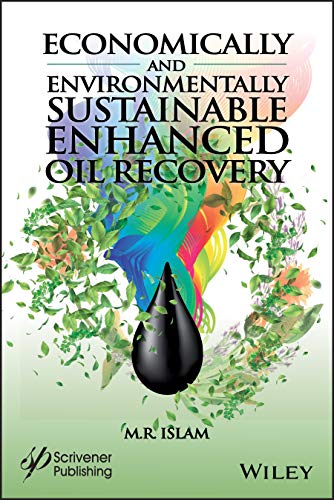
Economically and Environmentally Sustainable Enhanced Oil Recovery 1st Edition by Islam ISBN 1119479096 978-1119479093


Original price was: $50.00.$25.00Current price is: $25.00.
Economically and Environmentally Sustainable Enhanced Oil Recovery 1st Edition by Islam – Ebook PDF Instant Download/Delivery: 1119479096, 978-1119479093
Full download Economically and Environmentally Sustainable Enhanced Oil Recovery 1st edition after payment
Product details:
ISBN 10: 1119479096
ISBN 13: 978-1119479093
Author: Islam
There have been many books on the topic of Enhanced Oil Recovery (EOR) over the last 100 years. They all, however, focus on how to recover more oil faster, taking a rather myopic approach. The solutions presented all work fantastically in theory and even in the laboratory, but each fails to produce results in the field with long-term success. The petroleum industry is almost resigned to the belief that for an EOR technique to be successful, it must be propped up with public funds or must compromise environmental integrity. In line with modern engineering practices, previous books discuss how existing technologies can be tweaked to accommodate for any shortcomings that just came to light. This book is unlike any other book on the topic of recovery in particular and engineering in general.
This groundbreaking volume is a continuation of the author’s and his research group’s work that started publishing on the subject of global sustainability involving energy and the environment, dating back to early 2000s. Starting with a paradigm shift in engineering that involves a long-term focus, rather than looking for short-term solutions, the methods and theories presented here delve into applying green engineering and zero waste principles to EOR.
Historically, EOR has received mixed success, mainly because innovations in these disciplines relied heavily on processed materials, which are both uneconomical and toxic to the environment. This book explains how engineers missed entirely the causes of unsustainability in these technologies due to the prevalence of many myths that are embedded in modern engineering. Once these myths are deconstructed, the appropriate technologies emerge and the merits of them both in terms of economic and environmental benefits become clear.
The book reveals how previous practices in EOR can be replaced with their sustainable versions while saving in material costs. A number of innovative technologies are introduced that can render well known technologies, such as steam flood, in situ combustion, chemical flooding, and microbial EOR environmentally sustainable and economically attractive. A triple dividend is received once these technologies are applied in otherwise marginal reservoirs, unconventional plays and even abandoned formations. The overall reserve, which reflects recoverable oil with new technologies, goes up drastically. Further benefits are drawn when processes such as value addition of waste material is performed.
Overall this book shows how EOR can be rendered green while increasing the profitability. This is in stark contrast to the past practices that considered environmental integrity as a drain on profitability. This book proves that a paradigm shift can turn a “technological disaster” into a technological marvel.
Economically and Environmentally Sustainable Enhanced Oil Recovery 1st Table of contents:
1 Introduction
1.1 Opening Remarks
1.2 The Prophets of the Doomed Turned Into Scientists
1.3 Paradigm Shift in Sustainable Development
1.4 Questions Answered in This Book
2 Petroleum in the Big Picture
2.1 Introduction
2.2 Pre-Industrial Revolution Period
2.3 Beginning of the Petroleum Culture
2.4 The Information Age
2.5 The Energy Crisis
2.6 Conclusions
3 Natural Resources of the Earth
3.1 Introduction
3.2 Characteristic Time
3.3 Organic and Mechanical Frequencies
3.4 The Nature of Material Resources
3.5 The Science of Water and Petroleum
3.6 Nitrogen Cycle: Part of the Water/Nitrogen Duality
3.7 Conclusions
4 Growth Potential of Petroleum Reservoirs
4.1 Introduction
4.2 Toward Decarbonization
4.3 The Current State of the World of Oil and Gas
4.4 World Oil and Gas Reserve
4.5 Organic Origin of Petroleum
4.6 Scientific Ranking of Petroleum
4.7 Reserve Growth Potential of an Oil/Gas Reservoir
4.8 Conclusions
5 Fundamentals of Reservoir Characterization in View of Enhanced Oil and Gas Recovery
5.1 Introduction
5.2 Role of Fractures
5.3 Natural and Artificial Fractures
5.4 Developing Reservoir Characterization Tools for Basement Reservoirs
5.5 The Origin of Fractures
5.6 Seismic Fracture Characterization
5.7 Reservoir Characterization During Drilling
5.8 Reservoir Characterization with Image Log and Core Analysis
5.9 Major Forces of Oil and Gas Reservoirs
5.10 Reservoir Heterogeneity
5.11 Special Considerations for Shale
5.12 Conclusions
6 Future Potential of Enhanced Oil Recovery
6.1 Introduction
6.2 Background
6.3 Types of EOR
6.4 Enhanced Oil Recovery in Relation to Oil and Gas Reserve
6.5 Current Oil Fields
6.6 Need for EOR
6.7 Conclusions
7 Greening of Enhanced Oil Recovery
7.1 Introduction
7.2 Carbon Dioxide Injection
7.3 Thermal Methods
7.4 Chemical Methods
7.5 Gas Injection
7.6 Recap of Existing EOR Projects
7.7 Downhole Refinery
7.8 Conclusions
8 Toward Achieving Total Sustainability EOR Operations
8.1 Introduction
8.2 Issues in Petroleum Operations
8.3 Critical Evaluation of Current Petroleum Practices
8.4 Petroleum Refining and Conventional Catalysts
8.5 Current Practices in Exploration, Drilling and Production
8.6 Challenges in Waste Management
8.7 Greening of EOR Operations
8.8 Zero-Waste Operations
8.9 Conclusions
9 Conclusions
9.1 The Task
9.2 Conclusions
People also search for Economically and Environmentally Sustainable Enhanced Oil Recovery 1st :
how can a city be socially economically and environmentally sustainable
economically environmentally and socially sustainable
environmental and economical
environmentally and economically acceptable means
economically socially environmentally
You may also like…

Uncategorized

Uncategorized

Religion & Spirituality - Religious Studies
Explaining Islam Islam from a Catholic Perspective J. M. Gaskell
Uncategorized

Engineering - Environmental

Engineering - Environmental

Engineering - Chemical Engineering
Technique - Oil and Gas Technologies
Pipelines Emerging Technologies and Design Criteria 1st Edition M. Rafiqul Islam