
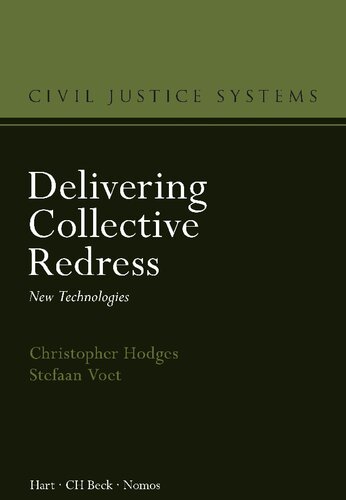
Delivering Collective Redress New Technologies 1st Edition by Christopher Hodges, Stefaan Voet ISBN 150991854X 978-1509918546


Original price was: $50.00.$25.00Current price is: $25.00.
Delivering Collective Redress New Technologies 1st Edition by Christopher Hodges, Stefaan Voet – Ebook PDF Instant Download/Delivery: 150991854X, 978-1509918546
Full download Delivering Collective Redress New Technologies 1st edition after payment
Product details:
ISBN 10: 150991854X
ISBN 13: 978-1509918546
Author: Christopher Hodges, Stefaan Voet
This book charts the transformative shifts in techniques that seek to deliver collective redress, especially for mass consumer claims in Europe. It shows how traditional approaches of class litigation (old technology) have been eclipsed by the new technology of regulatory redress techniques and consumer ombudsmen.
It describes a series of these techniques, each illustrated by leading examples taken from a 2016 pan-EU research project. It then undertakes a comparative evaluation of each technique against key criteria, such as effective outcomes, speed, and cost. The book reveals major transformations in European legal systems, shows the overriding need to view legal systems from fresh viewpoints, and to devise a new integrated model.
Delivering Collective Redress New Technologies 1st Table of contents:
1. Introduction: The Scope and the Criteria
I. Background and Principal Objective
II. The Techniques
III. Description of the Project and Methodology
IV. Criteria for Evaluation of Mechanisms
V. General Outline of this Book
VI. Major Findings
A. Empirical Findings
B. Changes in the Dispute Resolution Landscape
C. Fundamental Goals of Redress
D. The Objectives for Market Regulation
2. European Policy and Mechanisms for Collective Redress
I. Diverse Approaches and Piecemeal Legislation
II. The Public–Private Split
III. Objectives and Outcomes Replace Mechanisms
IV. Consumer Enforcement
A. The CPC Regulation
B. The Injunctions Directive
C. Small Claims
D. Consumer ADR
V. Consumer Collective Redress: Policy Debates
VI. Commission’s Recommendation on Collective Redress Mechanisms
A. Principles Common to Injunctive and Compensatory Collective Redress
B. Specific Principles Relating to Injunctive Collective Redress
C. Specific Principles Relating to Compensatory Collective Redress
D. Registry of Collective Redress Actions
E. Supervision and 2018 Report
VII. The Political and Technical Conundrum
VIII. Business Concerns on Ineffective Safeguards
IX. Consumer Concerns from Business Scandals
X. Proposals in 2016/17
XI. Competition Damages
A. Courage
B. Directive on Antitrust Damages Actions
XII. Data Protection
XIII. Investors
XIV. Conclusions
3. Collective Actions
I. Introduction
II. Belgium
A. Overview
B. Case Studies
III. Bulgaria
IV. England and Wales
A. Representative Action
B. Group Litigation Order (GLO)
C. Case Studies: GLO
D. The Competition Damages Class Action
E. Early Competition Damages Cases
F. Cases under the 2015 Competition Damages Action
V. Finland
VI. France
A. The Action de Groupe
B. Case Studies: Action de Groupe
C. The Action en Représentation Conjoint
VII. Germany
A. Representative Actions for Cease and Desist Orders
B. Actions for Skimming-off Illegally Gained Profits
C. Case Studies: Actions for Skimming-off Illegally Gained Profits
D. Test Case Proceedings by Consumer Associations
E. Capital Market Test Case Proceedings (KapMuG)
F. Case Studies: Capital Market Test Case Proceedings (KapMuG)
VIII. Italy
A. Class Actions
B. Case Studies: Class Actions
C. Representative Actions
IX. Lithuania
A. Representative Action Aiming to Protect the Public Interest
B. Group Actions
X. The Netherlands
XI. Poland
A. Polish Class Actions Act
B. Scope
C. Standardisation Requirement for Monetary Claims
D. Contingency Fees
E. Other Costs and Funding Issues
F. Security for Costs
G. Proceedings
H. Statistical Information
XII. Sweden
A. Group Actions
B. Case Studies: Group Actions
4. Criminal Compensation: Stand-alone and Consecutive Piggy-back
I. Belgium
A. Partie Civile Technique
B. Special Masters
II. United Kingdom
A. Compensation Orders in Criminal Proceedings
B. Disgorgement of Profits
5. Regulatory Redress
I. Concept
II. The Range of Mechanisms of Regulatory Redress
A. Influence
B. Approval
C. Coercion
III. Examples of the Powers
A. Belgium
B. Denmark
i. The ‘Opt-out’ Class Action
ii. Case Studies
C. Finland
D. Italy
i. The Italian Competition Authority
ii. The Italian Regulatory Authority for Electricity Gas and Water
iii. Institution for the Supervision of Insurance
iv. The Italian Data Protection Authority
v. The Italian Central Bank
vi. Evaluation
E. United Kingdom
i. Development of Regulatory Redress
ii. The 2015 Consumer Redress Powers
iii. Redress Powers in Selected Sectors
a. Financial Services
b. Communications
c. Gas and Electricity
d. Water
e. Railways
f. Environmental Protection
g. Gambling
h. Competition
6. Ombudsmen
I. Typology
II. National Ombudsmen Schemes
A. Belgium
i. Consumer Mediation Service
ii. Ombudsmen
iii. Belmed
B. France
i. Compensation Schemes
C. Italy
D. Sweden
i. The Group Procedure for Consumer Disputes
ii. Case Studies
E. The Netherlands
F. United Kingdom
i. The Landscape of Consumer Ombudsmen
ii. The Financial Ombudsman Service
iii. Integrated Voluntary, Regulatory and Ombudsman Redress: PPI
iv. Ombudsman Services: Energy, Communications, Property and Others
7. Reassessing the Objectives
I. The Primary Objectives
A. Subsidiary Process Objectives
II. Delivering Compensation
A. Social Solidarity and Risk Spreading
B. Justifications for Tort Liability
III. Affecting Future Behaviour
A. Deterrence in Traditional Legal Theory of Individual Actions and Enforcement
B. The Economic Theory of Deterrence
C. Criticisms of Economic Analysis of Liability Law
D. Adding the Time Dimension
E. Regulators’ Abandonment of Deterrence for Supportive Responsive Policies on Achieving Compliance
F. Affecting Corporate Behaviour
G. Behavioural Science on How People Make Decisions
H. Conclusions on Deterrence
IV. Empirical Evidence on the Failure of the US Class Action as a Regulatory Mechanism
V. The Objectives Restated: Multi-functionalism
8. Conclusions
I. Overview of the Mechanisms
A. Collective Actions
i. Italy
ii. Poland
iii. England and Wales
a. Examples of Cases
b. Assessment
B. Partie Civile
i. Examples of Cases
ii. Assessment
C. Regulatory Redress
i. Examples of Cases
ii. Assessment
D. Consumer Ombudsmen
i. Examples of Cases
ii. Assessment
II. Applying the Criteria
A. Criteria 1: Advice
B. Criteria 2: Identification of Infringement and Harm
C. Criteria 3: Identification of People Harmed and Due Redress
D. Criteria 4: Access
E. Criteria 5: Cost to Access
F. Criteria 6: Triage
G. Criteria 7: Duration
H. Criteria 8: Costs
I. Criteria 9: Outcomes
J. Criteria 10: Compensation for Loss: Making Whole
K. Criteria 11: Changes in Behaviour
L. Summary
III. Empirical Conclusions on the Mechanisms
IV. Implications of the Findings
A. Changes in the Dispute Resolution Landscape: A Shift to New Technologies
B. Redress as an Integral Function in Control of Markets
C. The Objectives for Market Regulation
D. A Shift in Intermediaries
E. Shifting from Old to New Technology
F. The Need for Independent Intermediaries
G. What Traditional Redress Systems Will Fail to Achieve
H. The Need to Re-examine Mechanisms for Controlling Market Behaviour (Enforcement)
I. Restatement of the Fundamental Goals of Redress Systems
J. Facilitating Settlement: The Requirement for Structures to be Available
K. The Requirement to Base Policy on an Examination of all the Options, and on Empirical Evidence
L. Summary of Implications for Policy on Collective Redress
Annex
I. Damages Cases
A. Collective Private Litigation
B. Civil Piggy-back on Criminal
C. Regulatory Redress
D. Ombuds
II. Cases Involving Injunctions/Market Behaviour (Not Compensation)
III. Cases Identified by BEUC and COJEF
People also search for Delivering Collective Redress New Technologies 1st :
delivering collective redress new technologies christopher hodges
types of consumer redress
collective redress
deliver technology llc
dred collective
Tags: Christopher Hodges, Stefaan Voet, Delivering Collective, New Technologies
You may also like…


Uncategorized

Poetry - General & Miscellaneous Poetry
New Critical Nostalgia 1st Edition by Christopher Rovee 9781531505141 1531505147


Politics & Philosophy - Government & Politics
Unbecoming Nationalism From Commemoration to Redress in Canada Helene Vosters

Computers - Applications & Software

Uncategorized


Uncategorized
Conform Fail Repeat How Power Distorts Collective Action 1st Edition Christopher Samuel