

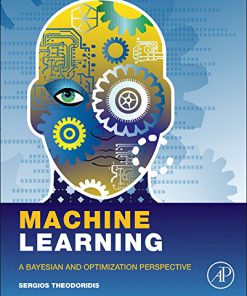
Machine Learning A Bayesian and Optimization Perspective 2nd Edition by Sergios Theodoridis ISBN 0128188030 978-0128188033


Original price was: $50.00.$25.00Current price is: $25.00.
Machine Learning A Bayesian and Optimization Perspective 2nd Edition by Sergios Theodoridis – Ebook PDF Instant Download/Delivery: 0128188030 , 978-0128188033
Full download Machine Learning A Bayesian and Optimization Perspective 2nd edition after payment
Product details:
ISBN 10: 0128188030
ISBN 13: 978-0128188033
Author: Sergios Theodoridis
Machine Learning: A Bayesian and Optimization Perspective, 2nd edition, gives a unified perspective on machine learning by covering both pillars of supervised learning, namely regression and classification. The book starts with the basics, including mean square, least squares and maximum likelihood methods, ridge regression, Bayesian decision theory classification, logistic regression, and decision trees. It then progresses to more recent techniques, covering sparse modelling methods, learning in reproducing kernel Hilbert spaces and support vector machines, Bayesian inference with a focus on the EM algorithm and its approximate inference variational versions, Monte Carlo methods, probabilistic graphical models focusing on Bayesian networks, hidden Markov models and particle filtering. Dimensionality reduction and latent variables modelling are also considered in depth.
This palette of techniques concludes with an extended chapter on neural networks and deep learning architectures. The book also covers the fundamentals of statistical parameter estimation, Wiener and Kalman filtering, convexity and convex optimization, including a chapter on stochastic approximation and the gradient descent family of algorithms, presenting related online learning techniques as well as concepts and algorithmic versions for distributed optimization.
Focusing on the physical reasoning behind the mathematics, without sacrificing rigor, all the various methods and techniques are explained in depth, supported by examples and problems, giving an invaluable resource to the student and researcher for understanding and applying machine learning concepts. Most of the chapters include typical case studies and computer exercises, both in MATLAB and Python.
The chapters are written to be as self-contained as possible, making the text suitable for different courses: pattern recognition, statistical/adaptive signal processing, statistical/Bayesian learning, as well as courses on sparse modeling, deep learning, and probabilistic graphical models.
Machine Learning A Bayesian and Optimization Perspective 2nd Table of contents:
Chapter 1: Introduction
Abstract
1.1. The Historical Context
1.2. Artificial Intelligence and Machine Learning
1.3. Algorithms Can Learn What Is Hidden in the Data
1.4. Typical Applications of Machine Learning
1.5. Machine Learning: Major Directions
1.6. Unsupervised and Semisupervised Learning
1.7. Structure and a Road Map of the Book
References
Chapter 2: Probability and Stochastic Processes
Abstract
2.1. Introduction
2.2. Probability and Random Variables
2.3. Examples of Distributions
2.4. Stochastic Processes
2.5. Information Theory
2.6. Stochastic Convergence
Problems
References
Chapter 3: Learning in Parametric Modeling: Basic Concepts and Directions
Abstract
3.1. Introduction
3.2. Parameter Estimation: the Deterministic Point of View
3.3. Linear Regression
3.4. Classification
3.5. Biased Versus Unbiased Estimation
3.6. The Cramér–Rao Lower Bound
3.7. Sufficient Statistic
3.8. Regularization
3.9. The Bias–Variance Dilemma
3.10. Maximum Likelihood Method
3.11. Bayesian Inference
3.12. Curse of Dimensionality
3.13. Validation
3.14. Expected Loss and Empirical Risk Functions
3.15. Nonparametric Modeling and Estimation
Problems
References
Chapter 4: Mean-Square Error Linear Estimation
Abstract
4.1. Introduction
4.2. Mean-Square Error Linear Estimation: the Normal Equations
4.3. A Geometric Viewpoint: Orthogonality Condition
4.4. Extension to Complex-Valued Variables
4.5. Linear Filtering
4.6. MSE Linear Filtering: a Frequency Domain Point of View
4.7. Some Typical Applications
4.8. Algorithmic Aspects: the Levinson and Lattice-Ladder Algorithms
4.9. Mean-Square Error Estimation of Linear Models
4.10. Time-Varying Statistics: Kalman Filtering
Problems
References
Chapter 5: Online Learning: the Stochastic Gradient Descent Family of Algorithms
Abstract
5.1. Introduction
5.2. The Steepest Descent Method
5.3. Application to the Mean-Square Error Cost Function
5.4. Stochastic Approximation
5.5. The Least-Mean-Squares Adaptive Algorithm
5.6. The Affine Projection Algorithm
5.7. The Complex-Valued Case
5.8. Relatives of the LMS
5.9. Simulation Examples
5.10. Adaptive Decision Feedback Equalization
5.11. The Linearly Constrained LMS
5.12. Tracking Performance of the LMS in Nonstationary Environments
5.13. Distributed Learning: the Distributed LMS
5.14. A Case Study: Target Localization
5.15. Some Concluding Remarks: Consensus Matrix
Problems
References
Chapter 6: The Least-Squares Family
Abstract
6.1. Introduction
6.2. Least-Squares Linear Regression: a Geometric Perspective
6.3. Statistical Properties of the LS Estimator
6.4. Orthogonalizing the Column Space of the Input Matrix: the SVD Method
6.5. Ridge Regression: a Geometric Point of View
6.6. The Recursive Least-Squares Algorithm
6.7. Newton’s Iterative Minimization Method
6.8. Steady-State Performance of the RLS
6.9. Complex-Valued Data: the Widely Linear RLS
6.10. Computational Aspects of the LS Solution
6.11. The Coordinate and Cyclic Coordinate Descent Methods
6.12. Simulation Examples
6.13. Total Least-Squares
Problems
References
Chapter 7: Classification: a Tour of the Classics
Abstract
7.1. Introduction
7.2. Bayesian Classification
7.3. Decision (Hyper)Surfaces
7.4. The Naive Bayes Classifier
7.5. The Nearest Neighbor Rule
7.6. Logistic Regression
7.7. Fisher’s Linear Discriminant
7.8. Classification Trees
7.9. Combining Classifiers
7.10. The Boosting Approach
7.11. Boosting Trees
Problems
References
Chapter 8: Parameter Learning: a Convex Analytic Path
Abstract
8.1. Introduction
8.2. Convex Sets and Functions
8.3. Projections Onto Convex Sets
8.4. Fundamental Theorem of Projections Onto Convex Sets
8.5. A Parallel Version of POCS
8.6. From Convex Sets to Parameter Estimation and Machine Learning
8.7. Infinitely Many Closed Convex Sets: the Online Learning Case
8.8. Constrained Learning
8.9. The Distributed APSM
8.10. Optimizing Nonsmooth Convex Cost Functions
8.11. Regret Analysis
8.12. Online Learning and Big Data Applications: a Discussion
8.13. Proximal Operators
8.14. Proximal Splitting Methods for Optimization
8.15. Distributed Optimization: Some Highlights
Problems
References
Chapter 9: Sparsity-Aware Learning: Concepts and Theoretical Foundations
Abstract
9.1. Introduction
9.2. Searching for a Norm
9.3. The Least Absolute Shrinkage and Selection Operator (LASSO)
9.4. Sparse Signal Representation
9.5. In Search of the Sparsest Solution
9.6. Uniqueness of the ℓ0 Minimizer
9.7. Equivalence of ℓ0 and ℓ1 Minimizers: Sufficiency Conditions
9.8. Robust Sparse Signal Recovery From Noisy Measurements
9.9. Compressed Sensing: the Glory of Randomness
9.10. A Case Study: Image Denoising
Problems
References
Chapter 10: Sparsity-Aware Learning: Algorithms and Applications
Abstract
10.1. Introduction
10.2. Sparsity Promoting Algorithms
10.3. Variations on the Sparsity-Aware Theme
10.4. Online Sparsity Promoting Algorithms
10.5. Learning Sparse Analysis Models
10.6. A Case Study: Time-Frequency Analysis
Problems
References
Chapter 11: Learning in Reproducing Kernel Hilbert Spaces
Abstract
11.1. Introduction
11.2. Generalized Linear Models
11.3. Volterra, Wiener, and Hammerstein Models
11.4. Cover’s Theorem: Capacity of a Space in Linear Dichotomies
11.5. Reproducing Kernel Hilbert Spaces
11.6. Representer Theorem
11.7. Kernel Ridge Regression
11.8. Support Vector Regression
11.9. Kernel Ridge Regression Revisited
11.10. Optimal Margin Classification: Support Vector Machines
11.11. Computational Considerations
11.12. Random Fourier Features
11.13. Multiple Kernel Learning
11.14. Nonparametric Sparsity-Aware Learning: Additive Models
11.15. A Case Study: Authorship Identification
Problems
References
Chapter 12: Bayesian Learning: Inference and the EM Algorithm
Abstract
12.1. Introduction
12.2. Regression: a Bayesian Perspective
12.3. The Evidence Function and Occam’s Razor Rule
12.4. Latent Variables and the EM Algorithm
12.5. Linear Regression and the EM Algorithm
12.6. Gaussian Mixture Models
12.7. The EM Algorithm: a Lower Bound Maximization View
12.8. Exponential Family of Probability Distributions
12.9. Combining Learning Models: a Probabilistic Point of View
Problems
References
Chapter 13: Bayesian Learning: Approximate Inference and Nonparametric Models
Abstract
13.1. Introduction
13.2. Variational Approximation in Bayesian Learning
13.3. A Variational Bayesian Approach to Linear Regression
13.4. A Variational Bayesian Approach to Gaussian Mixture Modeling
13.5. When Bayesian Inference Meets Sparsity
13.6. Sparse Bayesian Learning (SBL)
13.7. The Relevance Vector Machine Framework
13.8. Convex Duality and Variational Bounds
13.9. Sparsity-Aware Regression: a Variational Bound Bayesian Path
13.10. Expectation Propagation
13.11. Nonparametric Bayesian Modeling
13.12. Gaussian Processes
13.13. A Case Study: Hyperspectral Image Unmixing
Problems
References
Chapter 14: Monte Carlo Methods
Abstract
14.1. Introduction
14.2. Monte Carlo Methods: the Main Concept
14.3. Random Sampling Based on Function Transformation
14.4. Rejection Sampling
14.5. Importance Sampling
14.6. Monte Carlo Methods and the EM Algorithm
14.7. Markov Chain Monte Carlo Methods
14.8. The Metropolis Method
14.9. Gibbs Sampling
14.10. In Search of More Efficient Methods: a Discussion
14.11. A Case Study: Change-Point Detection
Problems
References
Chapter 15: Probabilistic Graphical Models: Part I
Abstract
15.1. Introduction
15.2. The Need for Graphical Models
15.3. Bayesian Networks and the Markov Condition
15.4. Undirected Graphical Models
15.5. Factor Graphs
15.6. Moralization of Directed Graphs
15.7. Exact Inference Methods: Message Passing Algorithms
Problems
References
Chapter 16: Probabilistic Graphical Models: Part II
Abstract
16.1. Introduction
16.2. Triangulated Graphs and Junction Trees
16.3. Approximate Inference Methods
16.4. Dynamic Graphical Models
16.5. Hidden Markov Models
16.6. Beyond HMMs: a Discussion
16.7. Learning Graphical Models
Problems
References
Chapter 17: Particle Filtering
Abstract
17.1. Introduction
17.2. Sequential Importance Sampling
17.3. Kalman and Particle Filtering
17.4. Particle Filtering
Problems
References
Chapter 18: Neural Networks and Deep Learning
Abstract
18.1. Introduction
18.2. The Perceptron
18.3. Feed-Forward Multilayer Neural Networks
18.4. The Backpropagation Algorithm
18.5. Selecting a Cost Function
18.6. Vanishing and Exploding Gradients
18.7. Regularizing the Network
18.8. Designing Deep Neural Networks: a Summary
18.9. Universal Approximation Property of Feed-Forward Neural Networks
18.10. Neural Networks: a Bayesian Flavor
18.11. Shallow Versus Deep Architectures
18.12. Convolutional Neural Networks
18.13. Recurrent Neural Networks
18.14. Adversarial Examples
18.15. Deep Generative Models
18.16. Capsule Networks
18.17. Deep Neural Networks: Some Final Remarks
18.18. A Case Study: Neural Machine Translation
18.19. Problems
References
Chapter 19: Dimensionality Reduction and Latent Variable Modeling
Abstract
19.1. Introduction
19.2. Intrinsic Dimensionality
19.3. Principal Component Analysis
19.4. Canonical Correlation Analysis
19.5. Independent Component Analysis
19.6. Dictionary Learning: the k-SVD Algorithm
19.7. Nonnegative Matrix Factorization
19.8. Learning Low-Dimensional Models: a Probabilistic Perspective
19.9. Nonlinear Dimensionality Reduction
19.10. Low Rank Matrix Factorization: a Sparse Modeling Path
19.11. A Case Study: FMRI Data Analysis
People also search for Machine Learning A Bayesian and Optimization Perspective 2nd:
machine learning a bayesian and optimization perspective pdf
machine learning a bayesian and optimization perspective 2nd edition pdf
machine learning a bayesian and optimization perspective 2nd edition
machine learning a bayesian and optimization perspective by sergios theodoridis
machine learning a bayesian and optimization
Tags: Sergios Theodoridis, Machine Learning, Optimization Perspective
You may also like…

Mathematics - Algebra
Uncategorized

Computers - Computer Science
Bayesian Optimization by Roman Garnett 9781108623551 1108623557
Computers - Computer Science
Machine Learning A Bayesian and Optimization Perspective 1st Edition Sergios Theodoridis


Computers
Computers - Artificial Intelligence (AI)
Natural Language Processing A Machine Learning Perspective Yue Zhang

Computers - Artificial Intelligence (AI)

Computers - Computer Science
Stochastic Optimization for Large-scale Machine Learning 1st Edition Chauhan