
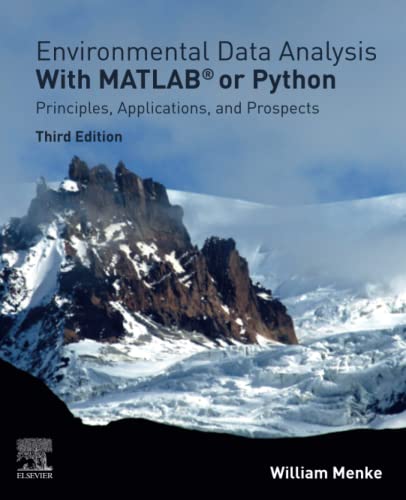
Environmental Data Analysis with MatLab or Python Principles, Applications, and Prospects 3rd Edition by William Menke 0323955768 9780323955768


Original price was: $50.00.$25.00Current price is: $25.00.
Environmental Data Analysis with MatLab or Python: Principles, Applications, and Prospects 3rd Edition by William Menke – Ebook PDF Instant Download/Delivery: 0323955768, 9780323955768
Full download Environmental Data Analysis with MatLab or Python: Principles, Applications, and Prospects 3rd Edition after payment
Product details:
ISBN 10: 0323955768
ISBN 13: 9780323955768
Author: William Menke
Environmental Data Analysis with MATLAB, Third Edition, is a new edition that expands fundamentally on the original with an expanded tutorial approach, more clear organization, new crib sheets, and problem sets providing a clear learning path for students and researchers working to analyze real data sets in the environmental sciences. The work teaches the basics of the underlying theory of data analysis and then reinforces that knowledge with carefully chosen, realistic scenarios, including case studies in each chapter. The new edition is expanded to include applications to Python, an open source software environment.
Environmental Data Analysis with MatLab or Python: Principles, Applications, and Prospects 3rd Table of contents:
Chapter 1 : Data analysis with MATLAB® or Python
Abstract
Keywords
Part A: MATLAB®
1A.1 Getting started
1A.2 Navigating folders
1A.3 Simple arithmetic and algebra
1A.4 Vectors and matrices
1A.5 Addition, subtraction and multiplication of column-vectors and matrices
1A.6 Element access
1A.7 Representing functions
1A.8 To loop or not to loop
1A.9 The matrix inverse
1A.10 Loading data from a file
1A.11 Plotting data
1A.12 Saving data to a file
1A.13 Some advice on writing scripts
Think before you type
Name variables consistently
Save old scripts
Cut and paste sparingly
Start small
Test your scripts
Don’t be too clever
Comment your scripts
Part B: Python
1B.1 Installation
1B.2 The first cell in the edapy_01 Jupyter Notebook
1B.3 A very simple Python script
1B.4 Navigating folders
1B.5 Simple arithmetic and algebra
1B.6 List-like data
1B.7 Creating column-vectors and matrices
1B.8 Addition, subtraction and multiplication of column-vectors and matrices
1B.9 Element access
1B.10 Representing functions
1B.11 To loop or not to loop
1B.12 The matrix inverse
1B.13 Loading data from a file
1B.14 Plotting data
1B.15 Saving data to a file
1B.16 Some advice on writing scripts
Think before you type
Name variables consistently
Save old scripts
Cut and paste sparingly
Start small
Test your scripts
Don’t be too clever
Comment your scripts
Problems
Chapter 2 : Systematic explorations of a new dataset
Abstract
Keywords
2.1 Case study: Black rock forest temperature data
2.2 More on graphics
2.3 Case study: Neuse River hydrograph used to explore rate data
2.4 Case study, Atlantic Rock dataset used to explore scatter plots
2.5 More on character strings
Problems
Chapter 3 : Modeling observational noise with random variables
Abstract
Keywords
3.1 Random variables
3.2 Mean, median, and mode
3.3 Variance
3.4 Two important probability density functions
3.5 Functions of a random variable
3.6 Joint probabilities
3.7 Bayesian inference
3.8 Joint probability density functions
3.9 Covariance
3.10 The multivariate normal p.d.f.
3.11 Linear functions of multivariate data
Problems
Reference
Chapter 4 : Linear models as the foundation of data analysis
Abstract
Keywords
4.1 Quantitative models, data, and model parameters
4.2 The simplest of quantitative models
4.3 Curve fitting
4.4 Mixtures
4.5 Weighted averages
4.6 Examining error
4.7 Least squares
4.8 Examples
4.9 Covariance and the behavior of error
Problems
Chapter 5 : Least squares with prior information
Abstract
Keywords
5.1 When least square fails
5.2 Prior information
5.3 Bayesian inference
5.4 The product of Normal probability density functions
5.5 Generalized least squares
5.6 The role of the covariance of the data
5.7 Smoothness as prior information
5.8 Sparse matrices
5.9 Reorganizing grids of model parameters
Problems
References
Chapter 6 : Detecting periodicities with Fourier analysis
Abstract
Keywords
6.1 Describing sinusoidal oscillations
6.2 Models composed only of sinusoidal functions
6.3 Going complex
6.4 Lessons learned from the integral transform
6.5 Normal curve
6.6 Spikes
6.7 Area under a function
6.8 Time-delayed function
6.9 Derivative of a function
6.10 Integral of a function
6.11 Convolution
6.12 Nontransient signals
Problems
Further reading
Chapter 7 : Modeling time-dependent behavior with filters
Abstract
Keywords
7.1 Behavior sensitive to past conditions
7.2 Filtering as convolution
7.3 Solving problems with filters
7.4 Case study: Empirically-derived filter for Hudson River discharge
7.5 Predicting the future
7.6 A parallel between filters and polynomials
7.7 Filter cascades and inverse filters
7.8 Making use of what you know
Problems
Reference
Chapter 8 : Undirected data analysis using factors, empirical orthogonal functions, and clusters
Abstract
Keywords
8.1 Samples as mixtures
8.2 Determining the minimum number of factors
8.3 Application to the Atlantic Rocks dataset
8.4 Spiky factors
8.5 Weighting of elements
8.6 Q-mode factor analysis
8.7 Factors and factor loadings with natural orderings
8.8 Case study: EOF’s of the equatorial Pacific Ocean Sea surface temperature dataset
8.9 Clusters of data
8.10 K-mean cluster analysis
8.11 Clustering the Atlantic Rocks dataset
Problems
References
Chapter 9 : Detecting and understanding correlations among data
Abstract
Keywords
9.1 Correlation is covariance
9.2 Computing autocorrelation by hand
9.3 Relationship to convolution and power spectral density
9.4 Cross-correlation
9.5 Using the cross-correlation to align time series
9.6 Least squares estimation of filters
9.7 The effect of smoothing on time series
9.8 Band-pass filters
9.9 Case study: Coherence of the Reynolds Channel water quality data
9.10 Windowing before computing Fourier transforms
9.11 Optimal window functions
Problems
References
Chapter 10 : Interpolation, Gaussian process regression, and kriging
Abstract
Keywords
10.1 Interpolation requires prior information
10.2 Linear interpolation
10.3 Cubic interpolation
10.4 Gaussian process regression and kriging
10.5 Example of Gaussian process regression
10.6 Tuning of parameters in Gaussian process regression
10.7 Example of tuning
10.8 Interpolation in two-dimensions
10.9 Fourier transforms in two dimensions
10.10 Using Fourier transforms to fill in missing data
Problems
References
Chapter 11 : Approximate methods, including linearization and artificial neural networks
Abstract
Keywords
11.1 The value of simplicity
11.2 Polynomial approximations and Taylor series
11.3 Small number approximations
11.4 Small number approximation applied to distance on a sphere
11.5 Small number approximation applied to variance
11.6 Taylor series in multiple dimensions
11.7 Small number approximation applied to covariance
11.8 Solving nonlinear problems with iterative least squares
11.9 Fitting a sinusoid of unknown frequency
11.10 The gradient descent method
11.11 Precomputation of a function and table lookups
11.12 Artificial neural networks
11.13 Information flow in a neural net
11.14 Training a neural net
11.15 Neural net for a nonlinear filter
Problems
References
Chapter 12 : Assessing the significance of results
Abstract
Keywords
12.1 Rejecting the Null Hypothesis
12.2 The distribution of the total error
12.3 Four important probability density functions
12.4 Case study with common hypothesis testing scenarios
12.5 Chi-squared test for generalized least squares
12.6 Testing improvement in fit
12.7 Testing the significance of a spectral peak
12.8 Significance of a spectral peak for a correlated time series
12.9 Bootstrap confidence intervals
Problems
Chapter 13 : Notes
Abstract
Keywords
13.1 Note 1.1 On the persistence of variables
13.2 Note 2.1 On time
13.3 Note 2.2 On reading complicated text files
13.4 Note 3.1 On the rule for error propagation
13.5 Note 3.2 On the eda_draw() function
13.6 Note 4.1 On complex least squares
13.7 Note 5.1 On the derivation of generalized least squares
13.8 Note 5.2 MATLAB® and Python functions
13.9 Note 5.3 On reorganizing matrices
13.10 Note 6.1 On the atan2() function
13.11 Note 6.2 On the orthonormality of the discrete Fourier data kernel
13.12 Note 6.3 On the expansion of a function in an orthonormal basis
13.13 Note 8.1 On singular value decomposition
13.14 Note 9.1 On coherence
13.15 Note 9.2 On Lagrange multipliers
13.16 Note 10.1 Covariance matrix corresponding to prior information of smoothness
13.17 Note 10.2 Issues encountered tuning Gaussian Process Regression
13.18 Note 11.1 On the chain rule for partial derivatives
People also search for Environmental Data Analysis with MatLab or Python: Principles, Applications, and Prospects 3rd:
environmental data analysis python
environmental data analysis matlab
time series analysis environmental data
environmental statistics using python
data analysis for environmental science
Tags: Data Analysis, Environmental, Principles, Applications, Prospects, William Menke
You may also like…

Computers - Programming
Data Analysis with Python and PySpark 1st Edition Jonathan Rioux

Uncategorized
Earth Sciences - The Environment
Environmental Data Analysis: Methods and Applications, 2nd 2nd Edition Zhihua Zhang
Engineering - Electrical & Electronic Engineering
Pattern Recognition and Data Analysis with Applications Deepak Gupta

Education Studies & Teaching - Studying & Test Preparation

Computers - Applications & Software
Earth Sciences - Geophysics
Environmental Data Analysis Methods and Applications 2nd Edition Zhihua Zhang

Computers - Organization and Data Processing

Computers - Computers - General & Miscellaneous
Dynamic System Modelling and Analysis with MATLAB and Python 1st Edition Jongrae Kim