
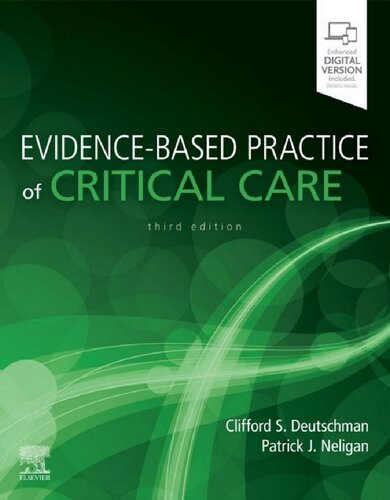
Evidence Based Practice of Critical Care 3rd Edition by Patrick Neligan 0323640688 9780323640688
Original price was: $50.00.$25.00Current price is: $25.00.
Evidence-Based Practice of Critical Care 3rd Edition by Patrick J. Neligan – Ebook PDF Instant Download/Delivery: 0323640688, 9780323640688
Full download Evidence-Based Practice of Critical Care 3rd Edition after payment
Product details:
ISBN 10: 0323640688
ISBN 13: 9780323640688
Author: Patrick J. Neligan
Evidence-Based Practice of Critical Care is a comprehensive clinical reference that integrates the best available scientific evidence with practical guidance for the management of critically ill patients. The 3rd edition reflects the latest advances in intensive care medicine, emphasizing evidence-based decision-making across a wide range of critical care scenarios.
Designed for intensivists, anesthesiologists, critical care nurses, residents, and fellows, the book combines concise literature reviews with clear clinical recommendations. It addresses diagnostic strategies, therapeutic interventions, and outcome-based practices essential for modern critical care units.
Evidence-Based Practice of Critical Care 3rd Table of contents:
SECTION 1. Critical Care and Critical Illness
1. Has evidence-based medicine changed the practice of critical care?
Looking beyond single randomized controlled trials
Small things make a big difference
Accountability is important
Do less, not more
It is not just the intensivist
Summary
References
2. Do protocols/guidelines actually improve outcomes?
What is a protocol?
What is a guideline?
How does a protocol differ from a guideline?
Epidemiology of protocols in the intensive care unit
Challenges for protocols in the intensive care unit
Protocol-driven care versus individualized care
Protocols and guidelines: Sepsis as a case study
How to develop a protocol locally
What outcomes should be used to validate a protocol or guideline?
Summary
References
3. What happens to critically ill patients after they leave the ICU?
Looking back to forward
Within the intensive care unit
On the medical wards
Post-acute care
Rehospitalization
Long-term survival
Long-term functional outcomes
Resilience and posttraumatic growth
Conclusion
References
4. What can be done to enhance recognition of the post-ICU syndrome (PICS)? What can be done to prevent it? What can be done to treat it?
What problems are prevalent among survivors of critical illness?
Which of the problems faced by survivors are consequences of critical illness?
Why does it matter whether the problem precedes critical illness or is a consequence of critical illness?
Given the absence of proven therapies, what can be done to enhance prevention, recognition, and treatment of PICS?
Conclusion
References
5. How have genomics informed our understanding of critical illness?
Introduction
Genomics discovery methods—briefly
Genomic diagnostic and prognostic biomarkers in sepsis
Effects of sepsis on gene expression
Genomic predictive biomarkers in sepsis and septic shock
Genomic diagnostic and prognostic biomarkers in acute respiratory distress syndrome
Diagnostic and prognostic biomarkers in ARDS
Genomic biomarkers in other critical illnesses
Genomics for drug discovery
References
SECTION 2. Basic Respiratory Management and Mechanical Ventilation
6. Is oxygen toxic?
Introduction
Mechanisms of toxicity—reactive oxygen species
The evidence for toxicity—from bench to bedside
Oxygen toxicity in practice—from the cradle to the grave
Hyperoxia and carbon dioxide
Hyperoxia in cardiac arrest, traumatic brain injury, and stroke
Therapeutic hyperoxia
Management and prevention of oxygen toxicity
Hyperbaric oxygen therapy and oxygen toxicity
References
7. What is the role of noninvasive respiratory support and high-flow nasal cannula in the intensive care client?
Introduction
Delivery of mechanical noninvasive respiratory support
Selecting patients for noninvasive respiratory support
Contraindications to noninvasive respiratory support
Applications of noninvasive respiratory support in the intensive care unit
Best evidence/first-line therapy
Moderate evidence for use
Conflicting evidence/deleterious effect
References
8. What is the role of PEEP and recruitment maneuvers in ARDS?
Introduction
Ventilator-induced lung injury
The open lung ventilation approach
Clinical trials of PEEP strategies
Clinical trials of recruitment maneuvers
Individualized PEEP titration at the bedside
Imaging
Oxygenation response to PEEP
Esophageal pressure
Compliance curves
Electrical impedance tomography
Conclusion and future directions
References
9. What is the best way to wean and liberate patients from mechanical ventilation?
Introduction
Clinical suspicion that weaning may be possible
Assessment of readiness to wean
Suitability for extubation
Ventilator management of the difficult-to-wean patient
References
10. How does mechanical ventilation damage lungs? What can be done to prevent it?
Introduction and definitions
How do ventilators damage the lungs in patients?
How to minimize lung damage
Conclusions
References
SECTION 3. Non-ARDS and Noninfectious Respiratory Disorders
11. How should exacerbations of COPD be managed in the intensive care unit?
Prevalence of COPD
Respiratory failure
Clinical precipitants of respiratory failure
Prognostic indicators in patients with acute exacerbations of COPD
Management of COPD
Prognosis and outcomes
End-of-life decisions in severe COPD
References
12. Is diaphragmatic dysfunction a major problem following mechanical ventilation?
Introduction
Definition and epidemiology
Pathogenesis
Clinical outcomes
Potential therapies
References
SECTION 4. ARDS
13. ARDS: Are the current definitions useful?
Introduction
Creating the berlin definition—an evidence-based consensus
The berlin definition
Comparing the berlin and AECC definitions
Comparing the berlin definition to lung pathology
Limitations of the berlin definition for recognition and management of ARDS
Conclusion
References
14. What are the pathologic and pathophysiologic changes that accompany ARDS?
Introduction
Pathogenesis
Iatrogenic lung injury
Physiologic consequences
Pathologic findings
References
15. What factors predispose patients to acute respiratory distress syndrome?
Predisposing conditions
Risk modifiers
Risk prediction models
Hospital-acquired exposures
References
16. What is the best mechanical ventilation strategy in ARDS?
Introduction
Ventilator-induced lung injury
Lung-protective ventilation
PEEP optimization and recruitment maneuvers
Driving pressure
Modes of ventilation
Neuromuscular blocking agents
Prone positioning
References
17. Is carbon dioxide harmful or helpful in ARDS?
Introduction
Physiologic effects of hypercapnia
Intracellular mechanisms of action of CO2
Role in clinical ards
Controversies and areas of uncertainty
Permissive hypercapnia at the bedside—practical issues
References
18. Does patient positioning make a difference in ARDS?
Introduction
Prone positioning in ARDS
Other positioning strategies
References
19. Do inhaled vasodilators in ARDS make a difference?
Introduction
Physiologic rationale
Nitric oxide
Prostaglandins
Comparisons of inhaled nitric oxide and prostaglandin
Reconciling the rationale with clinical research findings
Summary
References
20. Does ECMO work?
Introduction
Basics of ECMO
History, evolution, and current status of ECMO
ECMO physiology/gas exchange
Contraindications
VV ECMO cannulation strategies
ECMO: The evidence for its use in ARDS
Factors complicating the study of ECMO
References
21. What lessons have we learned from epidemiologic studies of ARDS?
Lesson 1: Critical care epidemiology is challenging
Lesson 2: ARDS is rare in the population but common in the adult ICU
Lesson 3: There are different ARDS phenotypes
Lesson 4: ARDS is underrecognized and treatment strategies underutilized
Lesson 5: ARDS may be preventable
Lesson 6: The trends in ARDS incidence and mortality are unknown
Conclusion
References
22. What are the long-term outcomes after ARDS?
Introduction
Survival after hospital discharge
Respiratory outcomes after ARDS
Health-related quality of life after ARDS
Post intensive care syndrome after ARDS
Conclusion
References
SECTION 5. General Critical Care Management
23. How do I approach fever in the intensive care unit and should fever be treated?
Critically ill patients with neurological disease
Critically ill patients with sepsis
Critically ill patients without sepsis or neurological disease
References
24. What fluids should be given to the critically ill patient? What fluids should be avoided?
Crystalloids
Colloids
In general ICU patients, what fluids should I give and what should I avoid?
In patients with sepsis, what fluids should I give and what should I avoid?
In trauma patients, what fluids should I give and what should I avoid?
In patients with hemorrhagic shock, what fluids should I give and what should I avoid?
In patients with burn injury, what fluids should I give and what should I avoid?
Conclusions
References
25. Should blood glucose be tightly controlled in the intensive care unit?
Pathophysiology and mechanism of action
Presentation of available data based on systematic review
Interpretation of data
Conclusion
References
26. Is there a role for therapeutic hypothermia in critical care?
Temperature monitoring
Cooling methods
Complications associated with therapeutic hypothermia
Mechanism of action of hypothermia
Hypothermia in cardiac arrest
Therapeutic hypothermia in ischemic stroke
Hypothermia for spinal cord injury
Hypothermia for traumatic brain injury
Hypothermia for acute myocardial infarction
Hypothermia for hypoxic-ischemic encephalopathy
Hypothermia in other clinical scenarios
Conclusion
References
People also search for Evidence-Based Practice of Critical Care 3rd:
evidence based practice of critical care
patrick j neligan critical care
critical care evidence based textbook
intensive care medicine reference
icu clinical decision making book
Tags: Evidence Based, Practice, Critical Care, Patrick Neligan
You may also like…
Uncategorized
Statistics for Nursing Research A Workbook for Evidence-Based Practice 3rd Edition Susan K. Grove
Medicine - Therapy
Evidence Based Practice of Cognitive Behavioral Therapy Second Edition Deborah Dobson

Uncategorized
Creating Practice Based Evidence 2nd Edition by Corinne Dobinson 1907826866 9781907826863

Medicine - Clinical Medicine
Maternal Fetal Evidence Based Guidelines 3rd Ed 3rd Edition Vincenzo Berghella
Medicine - Anesthesiology and Intensive Care
Principles and Practice of Critical Care Toxicology 1st Edition Singh Omender

Medicine - Nursing
Nursing Diagnosis Handbook: An Evidence-Based Guide to Planning Care 11th Edition Betty J. Ackley
Medicine - Clinical Medicine