
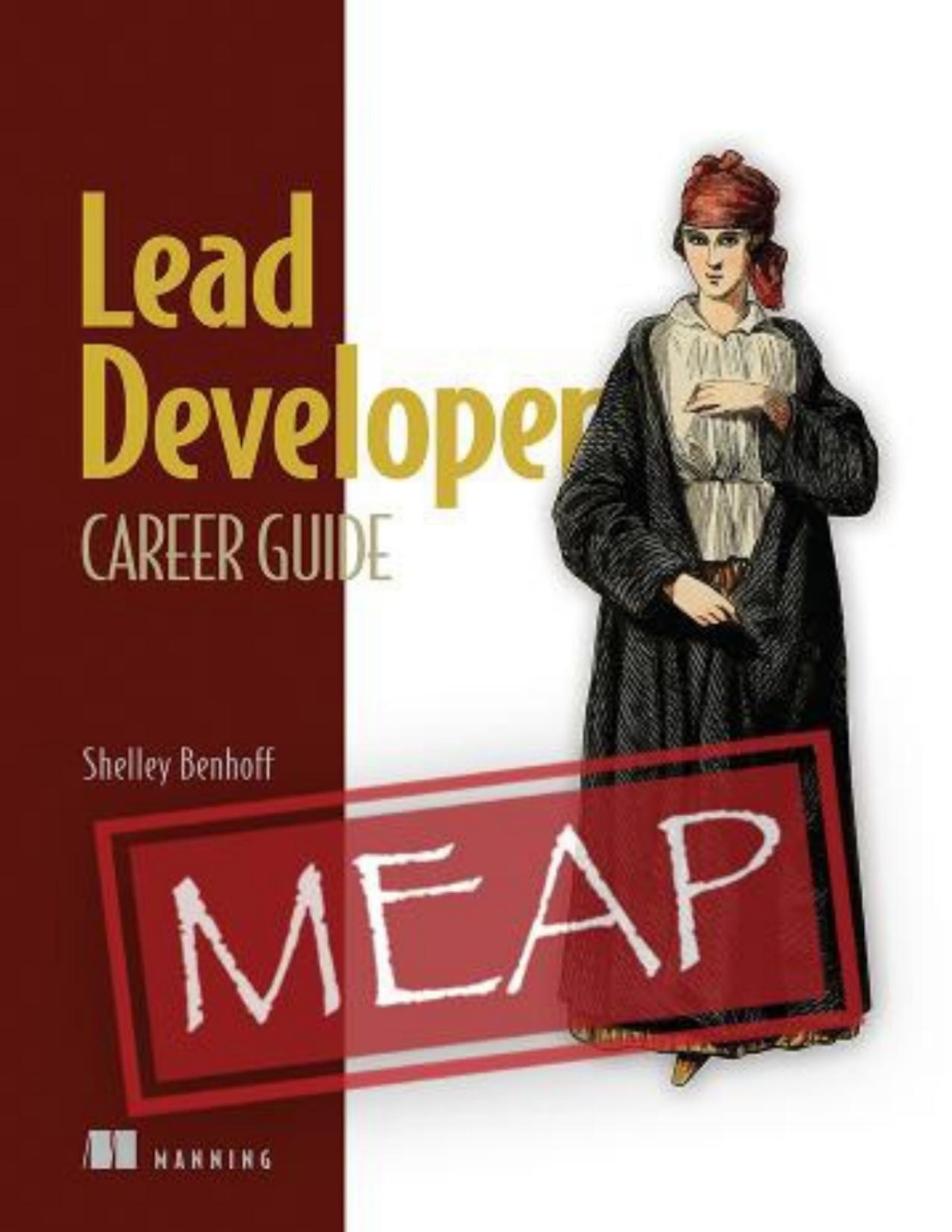
Lead Developer Career Guide MEAP V01 1st edition by Shelley Benhoff ISBN 1633438074 978-1633438071


Original price was: $50.00.$25.00Current price is: $25.00.
Lead Developer Career Guide – MEAP V01 1st edition by Shelley Benhoff – Ebook PDF Instant Download/Delivery: 1633438074, 978-1633438071
Full download Lead Developer Career Guide – MEAP V01 1st edition after payment
Product details:
ISBN 10: 1633438074
ISBN 13: 978-1633438071
Author: Shelley Benhoff
Learn the skills you need to be a lead developer, with expert advice on mentoring teams, handling clients and project managers, and keeping your head in emergencies.
The Lead Developer Career Guide teaches you how to transition from an individual contributor to a thriving lead developer. It’s packed with insider tips, tricks, and strategies drawn from author Shelley Benhoff’s 25-year career in technology, providing vital insights for navigating the unique challenges and expectations of the lead developer role. This one-of-a-kind book demonstrates how critical thinking and communication skills can elevate your career.
Lead Developer Career Guide – MEAP V01 1st Table of contents:
1 What is a lead developer?
1.1 Who can be a lead developer
1.1.1 Who this book is for
1.1.2 Reviewing top industries for lead developers
1.1.3 Being a successful lead developer
1.2 Lead developer tasks
1.2.1 Leading the development team
1.2.2 Working with project teams
1.2.3 Communicating with clients and stakeholders
1.2.4 Setting development standards
1.2.5 Building technical architecture
1.3 Lead developer expectations
1.3.1 Providing team support
1.3.2 Forming working relationships
1.3.3 Being a leader
1.4 Case study
1.4.1 What was your first experience as a lead developer?
1.4.2 What did you enjoy the most as a lead developer?
1.4.3 How did your experience as a lead developer set you up for success in your current job?
Summary
2 Lead developer career trajectory
2.1 Reviewing software developer roles
2.1.1 Starting as a junior developer
2.1.2 Becoming a senior developer
2.1.3 Moving to lead developer or lead architect
2.1.4 Considering management and beyond
2.1.5 Considering your career options
2.2 Moving through a software development career
2.2.1 Writing a résumé
2.2.2 Creating a cover letter
2.2.3 Achieving success in technical interviews
2.2.4 Interviewing for development leadership positions
2.3 The job market for lead developers
2.3.1 Assessing the competition
2.3.2 Standing above the crowd
2.3.3 Reviewing in-demand technical skills
2.4 Case study
2.4.1 What advice do you have for developers who are setting a career plan?
2.4.2 How can developers stay on top of the competition in today’s job market?
2.4.3 How can developers stand out during the interview process?
Summary
3 Learning lead developer skills
3.1 Prioritizing learning new skills
3.1.1 Learning current technical skills
3.1.2 Reviewing necessary soft skills
3.1.3 Practicing soft skills on the job
3.1.4 Setting aside time for learning
3.2 Finding your leadership style
3.2.1 Reviewing popular leadership styles
3.2.2 Assessing your personality type
3.2.3 Observing personalities on your team
3.3 Improving your presentation skills
3.3.1 Calming your nerves
3.3.2 Creating effective slides
3.3.3 Giving a great performance
3.4 Case study
3.4.1 What soft skills have you learned that helped you most in your career?
3.4.2 How do you prepare for giving a presentation?
3.4.3 Why is it important to observe personalities on your team?
3.4.4 What advice do you have for lead developers with a busy schedule to help them prioritize learning new skills?
Summary
4 Learning any developer skill
4.1 Improving your learning methods
4.1.1 Understanding how you learn
4.1.2 Boosting your memory
4.1.3 Taking care of your physical and mental health
4.1.4 Teaching while you learn
4.2 Applying your skills
4.2.1 Developing personal projects
4.2.2 Working on community projects
4.2.3 Creating prototypes
4.3 Overcoming learning blockers
4.3.1 Taking breaks
4.3.2 Setting attainable goals
4.3.3 Seeking help
4.4 Case study
4.4.1 How can a developer find community projects, and how can they get involved?
4.4.2 How can a developer find the help they need to overcome learning blockers?
4.4.3 What would you tell a developer who feels inadequate because they aren’t working on as many community projects as other developers in their network?
4.4.4 How do you like to learn new skills?
Summary
5 Writing technical documentation
5.1 Setting the team up for success
5.1.1 Documenting everything
5.1.2 Managing technical debt
5.1.3 Onboarding new developers
5.2 Structuring documentation
5.2.1 Chunking the content
5.2.2 Using visual aids
5.2.3 Including an introduction and summary
5.3 Creating the content
5.3.1 Starting with an outline
5.3.2 Writing specific instructions
5.3.3 Getting right to the point
5.3.4 Using a style guide
5.4 Implementing a documentation maintenance cycle
5.4.1 Testing the documentation
5.4.2 Getting feedback
5.4.3 Setting a documentation maintenance window
5.5 Case study
5.5.1 How has writing proper documentation helped you set your team up for success?
5.5.2 Have you received feedback from other developers about your documentation? Did they suggest any improvements, and what were the suggestions?
5.5.3 What if someone has never written technical documentation before? What is your advice to help them get started?
5.5.4 Have you used any AI tools for writing technical documentation, and what was the result?
Summary
6 Optimizing the development process
6.1 Identifying opportunities for process improvement
6.1.1 Recognizing pain points
6.1.2 Providing ideas for improvement
6.1.3 Using AI coding tools
6.1.4 Managing the development process
6.2 Receiving feedback
6.2.1 Interviewing stakeholders
6.2.2 Being open to constructive criticism
6.2.3 Keeping an open mind
6.3 Reviewing the software development lifecycle
6.3.1 Identifying opportunities for automation
6.3.2 Removing bottlenecks
6.3.3 Using a preventative versus reactionary approach
6.4 Maintaining the development process
6.4.1 Documenting the development process
6.4.2 Documenting the quality assurance process
6.4.3 Setting a development process maintenance schedule
6.5 Case study
6.5.1 What pain points have you encountered in the development process, and how did you address them?
6.5.2 What are some ways that you’ve reduced technical debt?
6.5.3 What advice do you have for lead developers to ensure that their development process is optimized?
Summary
7 Working with project teams
7.1 Cross-training project management skills
7.1.1 Reviewing the waterfall method
7.1.2 Defining agile
7.1.3 Comparing agile to waterfall
7.2 Providing accurate estimates
7.2.1 Measuring hourly estimates
7.2.2 Estimating in story points
7.2.3 Including the team
7.3 Facilitating communication
7.3.1 Connecting team members
7.3.2 Asking for help
7.3.3 Avoiding miscommunication
7.4 Improving project management processes
7.4.1 Supporting project managers
7.4.2 Integrating deployments with project management systems
7.4.3 Assessing your defect rate
7.5 Case study
7.5.1 How do you avoid miscommunication with your team members, and what are some important strategies you use?
7.5.2 Why is it important to ask for help?
7.5.3 How do you support project managers?
7.5.4 How do you connect team members with the people and resources they need to finish a task if they’re struggling?
Summary
8 Speaking with clients
8.1 Understanding your clients’ needs
8.1.1 Using active listening
8.1.2 Asking insightful questions
8.1.3 Interviewing the end user
8.2 Suggesting technical approaches
8.2.1 Understanding wants vs. needs
8.2.2 Considering the budget
8.2.3 Presenting your case
8.3 Forming relationships with clients
8.3.1 Establishing trust with clients
8.3.2 Getting to know your clients
8.3.3 Remaining diplomatic
8.4 Dealing with difficult clients
8.4.1 Staying calm
8.4.2 Letting them talk
8.4.3 Remaining engaged
8.5 Case study
8.5.1 How do you establish trust with your clients?
8.5.2 How do you handle clients who request features that are out of scope?
8.5.3 What makes a successful presentation to outline your technical approach?
8.5.4 How have you dealt with difficult clients?
Summary
9 Being a mentor
9.1 What is a mentor?
9.1.1 Comparing mentors and trainers
9.1.2 Mentoring expectations
9.1.3 Achieving success as a mentor
9.2 Forming relationships with mentees
9.2.1 Establishing trust with mentees
9.2.2 Getting to know your mentees
9.2.3 Finding common ground
9.3 Inspiring personal and career growth
9.3.1 Making a career plan
9.3.2 Identifying skills to improve
9.3.3 Being a role model
9.4 Paying it forward
9.4.1 Empowering mentees to become mentors
9.4.2 Mentoring people outside of your organization
9.4.3 Participating in mentoring communities and events
9.5 Case study
9.5.1 Tell a story about one of your many achievements as a mentor. How did you help your mentees, and what success did they achieve?
9.5.2 How do you help a mentee make their career plan?
9.5.3 Do you have any examples of mentoring communities or events? What is your experience with these events?
9.5.4 What advice do you have for lead developers who have never mentored anyone before?
Summary
10 Taking the lead
10.1 Providing instructions
10.1.1 Speaking with confidence
10.1.2 Being clear and concise
10.1.3 Documenting frequently asked questions
10.2 Giving feedback
10.2.1 Providing positive feedback
10.2.2 Giving negative feedback
10.2.3 Planning feedback sessions
10.3 Handling emergencies
10.3.1 Remaining positive
10.3.2 Bringing the team together
10.3.3 Outlining a plan
10.4 Improving your confidence
10.4.1 Assessing your strengths and weaknesses
10.4.2 Avoiding comparing yourself to others
10.4.3 Challenging negative thoughts
10.5 Case study
10.5.1 How did you know you were ready to be a leader?
10.5.2 How do you give negative feedback?
10.5.3 What is your experience with leading a team through an emergency?
10.5.4 eWhat advice do you have for lead developers who aren’t sure if they are ready to take the lead?
Summary
11 Leading with emotional intelligence
11.1 What is emotional intelligence?
11.1.1 Understanding the four-branch model
11.1.2 Teaching yourself to be emotionally intelligent
11.1.3 Teaching your team to be emotionally intelligent
11.2 Using emotional intelligence
11.2.1 Becoming self-aware
11.2.2 Managing working relationships
11.2.3 Achieving personal growth
11.3 Learning radical empathy
11.3.1 Comparing empathy to radical empathy
11.3.2 Understanding others
11.3.3 Connecting on a deeper level
11.4 Having difficult conversations
11.4.1 Preparing before the conversation
11.4.2 Listening more than you talk
11.4.3 Following up on difficult conversations
11.5 Avoiding imposter syndrome
11.5.1 Practicing self-compassion
11.5.2 Sharing your feelings
11.5.3 Discouraging perfectionism
11.6 Case study
11.6.1 How has practicing empathy affected your relationships at work?
11.6.2 What lessons have you learned through self-awareness?
11.6.3 How can emotional intelligence help balance a difficult conversation?
11.6.4 What advice do you have for practicing emotional intelligence in the workplace?
Summary
12 Being a successful lead developer
12.1 Assessing your skill level
12.1.1 Shadowing other lead developers
12.1.2 Building technical architecture from scratch
12.1.3 Cultivating a positive working environment
12.2 Taking the leap
12.2.1 Gathering a group of mentors
12.2.2 Starting your first project
12.2.3 Setting yourself up for success
12.3 Working with management
12.3.1 Planning a budget
12.3.2 Hiring developers
12.3.3 Firing developers
12.3.4 Setting policies for AI tools
People also search for Lead Developer Career Guide – MEAP V01 1st:
lead developer career guide pdf
lead developer career guide pdf download
ead developer career guide shelley benhoff
lead developer career guide pdf free
lead developer career guide manning
You may also like…

Computers - Web Development

Computers - Programming

Engineering - Computer Technology

Computers - Programming

Computers - Artificial Intelligence (AI)
Computers - Programming

Computers - Professionals
Lead Developer Career Guide MEAP V04 1st Edition by Shelley Benhoff ISBN 1633438074 9781633438071

Computers - Artificial Intelligence (AI)
The AI-Powered Developer MEAP V01 1st Edition by Nathan B Crocker ISBN 1633437612 9781633437616