
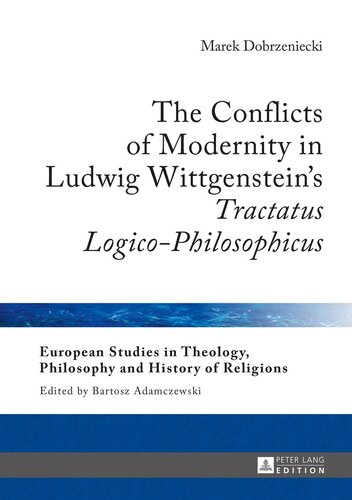
The Conflicts of Modernity in Ludwig Wittgenstein’s 1st edition by Marek Dobrzeniecki ISBN 3631667809 978-3631667804


Original price was: $50.00.$25.00Current price is: $25.00.
The Conflicts of Modernity in Ludwig Wittgenstein’s 1st edition by Marek Dobrzeniecki – Ebook PDF Instant Download/Delivery: 3631667809 , 978-3631667804
Full download The Conflicts of Modernity in Ludwig Wittgenstein’s 1st edition after payment
Product details:
ISBN 10: 3631667809
ISBN 13: 978-3631667804
Author: Marek Dobrzeniecki
The author offers a new look at one of the most influential books in the history of philosophy: Ludwig Wittgenstein’s Tractatus Logico-Philosophicus. He presents the Tractatus as expressing the intellectual anxieties of its modernist epoch. The most intriguing but usually unanswered question concerning the Tractatus is why Wittgenstein had to think that only propositions of natural science have meaning. The author reviews the most popular interpretations of the Tractatus and comes to the conclusion that the early Wittgenstein was an ethical subjectivist. With this insight, he solves the tension between Tractarian theses that influenced neopositivism and its mystical part.
The Conflicts of Modernity in Ludwig Wittgenstein’s 1st Table of contents:
Chapter 1. The Problem of Ontology in the Tractatus
1.1 Anti-metaphysical interpretation of the Tractatus
1.1.1 Anti-metaphysical interpretation and the tasks of philosophy
1.1.2 The context principle in the Tractatus
1.1.3 In defence of semantic atomism
1.2 The Argument for Substance
1.2.1 The argument from the false judgement or thinking what is not
1.2.2 The argument from the determinateness of sense
1.2.3 Zalabardo’s objections
Summary
Chapter 2. The Simple Objects of the Tractatus
2.1 Phenomenalistic interpretation of the simples
2.1.1 The question of Russell’s influence on the Tractatus
2.1.2 Arguments in favour of the phenomenalistic interpretation
2.1.3 Counterarguments
2.2 Materialistic interpretation of the simples
2.2.1 Simple objects as material points, point-masses or physical atoms
2.2.2 Arguments in favour of the materialistic interpretation
2.2.3 Advantages of the materialistic interpretation
2.2.4 Counterarguments
2.3 Resolute interpretation of the Tractatus
2.3.1 The principles of the resolute interpretation
2.3.2 The notion of philosophy in the Tractatus
Summary
Chapter 3. Wittgenstein’s Theory of Judgement
3.1 The context of Wittgenstein’s theory
3.1.1 Russell’s theory of judgement
3.1.2 The notion of the empirical self
3.2 Wittgenstein’s criticism of Russell’s views on judgement
3.3 The Tractatus 5.54-5.5422
3.3.1 Conceptual clarifications
3.3.2 The form of “A believes that p” according to Wittgenstein
3.3.3 Consequences of Wittgenstein’s theory of judgement
3.3.4 The repudiation of the existence of the complex soul (TLP 5.5421)
3.4 Other interpretations of TLP 5.54-5.5422
3.4.1 Anscombe: TLP 5.54-5.5422 and the extensionality principle
3.4.2 Hacker: Hume’s influence on Wittgenstein’s theory
3.4.3 Jacquette: the distinguishability problem
Summary
Chapter 4. The Transcendental Self
4.1 The transcendental philosophy of Schopenhauer
4.1.1 Schopenhauer and the notion of the transcendental self
4.1.2 Schopenhauer and the safeguarding of values
4.2 The willing subject
4.2.1 Examples of transcendental interpretations referring to Wittgenstein’s ethics
4.2.2 Counterarguments
4.3 Solipsistic theses of the Tractatus
4.3.1 The transcendental self as the owner of the phenomenal world
4.3.2 The transcendental self as the linguistic soul
4.3.3 Arguments in favour of Tractarian transcendental solipsism
4.4 Tractarian understanding of death
4.5 General remarks about the transcendental interpretation
4.5.1 Is the nonsense of solipsism illuminating?
4.5.2 Transcendental reasoning
Summary
Chapter 5. Ethics in Wittgenstein’s Early Writings
5.1 The nonsense of ethics in the eyes of early Wittgenstein
5.1.1 The absoluteness of moral values
5.1.2 The sense of proposition and the idea of objectivity
5.2 Early Wittgenstein’s subjectivism
5.2.1 Ethical sentences as expressions of attitudes
5.2.2 Ethical subjectivism and Tractarian silence
5.2.3 Wittgenstein’s subjectivism and early Russell’s emotivism
5.3 Solipsistic theses of the Tractatus under a subjectivist reading
People also search for The Conflicts of Modernity in Ludwig Wittgenstein’s 1st :
ludwig wittgenstein main ideas
ludwig wittgenstein postmodernism
ludwig wittgenstein influenced by
the conflict between traditional and modern was reflected in
why was ludwig wittgenstein important
Tags: Marek Dobrzeniecki, The Conflicts, Ludwig Wittgenstein’s
You may also like…

Uncategorized
Exodus Numbers European Studies in Theology Philosophy and History of Religions Adamczewski
Politics & Philosophy - Philosophical Positions & Movements

Uncategorized


Uncategorized

Religion & Spirituality - Bible


Religion & Spirituality - Bible
The Gospel of Matthew A Hypertextual Commentary European Studies in Theology Philosophy and History of Religions Book 16 by Adamczewski 9783631707876 3631707878
$50.00Original price was: $50.00.$25.00Current price is: $25.00.